27 July 2009

questioning my sanity


Next weekend, we'll have our annunal summer party at our house. Both my in-laws and us have invited all our friends, families, colleagues and neigbours, and we'll be around sixty to seventy people.

And together with my lovely wife, we'll be cooking for all of them.

I know, quite some people have already mentioned in rather frank words that they think I am insane putting up with all that work. But I love every minute of it, it is like an extra holiday for me. Especially this year, as I have taken a day off work on both friday and monday and therefore all will be moving along rather leisurely.

Even the weather forcast look great *knocks on wood*, much better than the years before. Three years ago, we had 8°C on a early august afternoon, can you believe it?

But probably the main difference this year will be the fact that I will (try to) make all the breads myself. I already mentioned some people are questioning my sanity?

So I have been tinkering around with my favourite breads, trying to come up with something interesting to add a little colour to the bread basket. Yesterday, I finally made a version of a spiced rye bread, the way it is popular in south Germany, that I really liked. Mostly caraway, but also fennel, anis and cardamon blend so well with the sourdough rye that they add complexity but do not overwhelm the bread flavour itself.

It is not too different from my 'partial' rye bread - just a little tweaked with a darker crust. But it is a lovely bread to have with just a little butter and salt, together with a nice salad and a big, cool beer.

Just the right thing for a summer party...


Caraway Rye Bread
(makes one 1.2 kg loaf)


levain
100g wholegrain rye flour (German type 1150)
50ml water
80g sourdough starter (100% hydration rye)

final dough
200g medium to fine rye meal
100g high-gluten wheat flour (German type 550)
350g wholegrain wheat flour (German type 1050)
3 1/2 teaspoons salt
1 teaspoon dry yeast
2 teaspoons caraway seeds
1/2 teaspoon anisseed
1/2 teaspoon fennel seed
1/2 teaspoon cardamon seed
420 ml water, lukewarm


The day before baking, mix all the ingredients for the levain and leave to ferment for 12 hours at room temperature.
Twelve hours are a rough guideline. It'll work just as good if you keep it fermenting longer.

The day of baking, roughly grind the spices in a mortar or a spice grinder. Mix with all the remaining ingredients and the levain and knead until medium gluten developement.
Of course you could leave the spices whole, but I find them too distracting, intense as they are, and prefer them a little broken down.

Leave to proof for 2 hours at room temperature.

Then, shape into a light ball, if possible without de-gassing the dough, and leave to rest for another half an hour.
Simplest way to pre-shape the dough would be pouring it onto a lightly floured surface and tucking the fringes underneath itself just once or twice so it is more or less round and the dough's surface taut as a bedsheet.

After that, shape the dough again as above, this time turning it around and sealing the seam with a few deft pinches. Put seam-up into a well-floured couche and leave to proof for another 1,5 hours.
Once again, I proofed the dough in a colander lined with a well-floured tea towel, and it worked flawlessly. I also made a longer loaf, almost like a batard, by using a rectangular cake tin instead of a colander.

Preheat the oven to 250°C.
More and more I come to the conclusion that it is not enough to have the oven thermometre show the desired temperature. If I let the oven heat up another twenty minutes then, the temperature loss from openeing the door and steaming is significantly less and makes for a much better crust.

Once the dough is ready, flip seam-side down onto a baking sheet and score.

Bake at a low rack with steam for about 20 minutes, then reduce the temperature to 210°C. Bake for another 40 minutes until the crust is dark and fragrant.
For baking with steam see my descriptions here.

Switch off the oven but leave the bread inside to cool for another 10 to 15 minutes with the door ajar inprove the crust.

Set on a rack to cool completely before cutting.


P.S.: And once more, this post is submitted to the YeastSpotting section of Susan's formidable blog Wild Yeast. I can't really recomment her site enough, it is a constant inspiration for me.

26 July 2009

smelled so good


Who says you can't have fun and learn something new at the same time?

Last night a dear colleague of mine had her annual summer party. You know, she of cantuccini and rasberry parfait fame.

As centrepiece of her buffet, she had a whole gyros skewer. A whole, life-size one for seventy people. So awesome!


(Not me, nor the actual skewers. As I didn't have my camara with me, this picture is curtesy of wikimedia commons, just to get an idea of what I am talking about.)

And best thing, I even got a go at trying to cut the meat properly! I can now honestly say that it takes a lot of practise to get thin slices off that huge beast, but it was great fun, very tasty, hot and smelled soooo good...

Now this makes for a very nice memory.

19 July 2009

grandma's little helper


The evolution of recipies is a funny thing.

This one started out as my grandmother's classic goulash, then became my mother's 'goulash with mushrooms', my 'meat stew' and finally, I realized it had become somthing rather close to the classic 'boef bourguignon'.

It is so far removed from its origins now that they hardly resemble each other, apart from both being braised meat with lots of gravy. But this version, with its intense taste, the gravy looking almost like crude oil and its endless adaptability holds a special place in my little brown book. (Which is where I scribble my cooking notes, edit and re-edit them until they become stable recipes.)

For one, this recipe works especially well with venison. You could use beef, but that would be a little unnecessary, especially as the cheaper venison cuts from legs and neck are really cheap when it's in season here. This is a recipe that explicitly benefits from more marbled meat with occasional cartilage and ligaments, as the long cooking time will mostly melt them and they'll add a wonderful, meaty and sticky quality to the gravy that you'd never get with a lean, expensive cut.

Most of the time, we use stag, as our wholesale market stocks it frozen and at a really good value all year round. But it works equally well with boar, or basically any other venison, even mixed. The stronger taste of game meat is perfectly suited to hold its own against the strong taste of the gravy, making it a perfect meal when you need something comforting, strong, invigourating your senses.

As almost any greens and sides work well with this dish, it is also one of my standarts when I want to clean out the freezer. And, as it freezes really well, I often make 'venison pie' from leftover stew and some puff pastry.

You see, it's just too useful (and tasty) recipe not to have in your repertoire.


stag 'bourguignon'
(serves four)


250g bacon in thick pieces

1kg stag (or boar, basically any venison except poultry)

1 medium onion, diced
4-6 cloves garlic
4 bay leaves
1 teaspoon juniper berries
1 teaspoon white pepper, ground
one bottle dry red wine
0,5l water

2 tablespoons black currant jelly (or more to taste)
salt


Cut the bacon into large pieces, like in the picture below, and gently brown in a large, heavy, oven-proof pot.
This is not to crisp the bacon, only to render out some of the fat so you don't need any additional oil to brown the meat.

Take out the bacon and set aside.

If necessary, clean the meat of any skin or thick tendons and cut into pieces the size somewhere between a golf- and a baseball. Fry at very high heat in the rendered bacon fat until very dark, allmost burned, though not necessarily done.
This step is essential for the colour of the final dish, so invest a little time here. (See 'Grandma's little helper' for troubleshooting, below.)


Return the bacon, add the spices and deglaze with the wine and the water.
If you have like a cheesecloth sachet for the spices, this would be the moment to use it for the juniper and the bay leaves. Juniper berries can be pretty vile if you bite on them, even though they are easy to spot and pick out later on. I never use one myself, I have to admit...

Put in the oven at about 180°C until the meat is spoon-tender, about two to two-and-a-half hours. Check occasionally if there is still enough liquid, if not add some water.

Take out of the oven and add the black currant jelly. Correct the seasoning if necessary, but usually the bacon will have been salty enough already.

Depending on how thick you like the gravy, thicken with a little flour mixed in cold water, some beurre manie or the commercial thickener of your choice.
Also, if the colour of the stew is not as appetizingly dark as one could wish for, I correct this with a few drops of caramel color, one of the priceless little helpers I gleaned from my grandmother. (This is especially usefull when in the hurry of the day one didn't have the time to sear the meat properly, and actually had to throw the block of frozen meat into the oven with the cold wine and the spices before hurrying off to the next appointment...)

Can be served with almost any vegetables, potatoes seem to be a must.
I prefer string beans, with lots of butter and garlic, and Rösti with a little molten cheese on top.

Keeps well in the fridge, freezes and reheats perfectly well.

14 July 2009

take a pot of smetana


Summer is barbecue time. And I just love the fact that I can throw almost anything onto the grill and it turns into a great meal with close to no effort, just a little sensitive timing. I mean, look at this:


This is basically nothing but a riff on my gambas con aioli. Only that instead of the delicious but rather heavy aioli I made a garlic smetana. Smetana is a close relative of creme fraiche, and is widely used in the cuisine of the region I am living in. It's got a relatively high fat contend, so it's far from being actually light, but much lighter than a purely oil-based aioli never the less.

And the recipe is basically the same as with the aioli, just instead of a mayonnaise base, you take a pot of smetana. Add the crushed garlic, the salt, honey and the lemon juice, and that's about it. Try it, you'll be surprised how versatile this dip is.

12 July 2009

gorgeous stuff


One of the nice things of summer apart from the weather is that my garden supplies me with a constant, well-ordered stream of fruit that somehow I have to incorporate into our diet.

The strawberries are almost over now, the rasberries are in their last hurrah, coming up next are gooseberries and red currants. The peaches and grapes are coming along nicely. The cherries seem to have skipped this year, for whatever reason, but the berries and apples are more than we ever had.

As I couldn't stand the thought of yet another rasberry cake (and they are my absolute favourites) it took me a while to come up with an idea of what to make with the daily harvest and the last few lonely strawberries.

For quite a while now, homemade ice-cream has been on my mind, but my experiments had yet to yield any edible results. And as I had shied away from buying a machine so far, it didn't look like I was going anywhere that direction any time soon.

But, (You knew there was a but coming up, didn't you?) bless my colleague, I had a recipe for rasberry parfait lying around somewhere, gathering dust. It seemed like a good moment to try my luck and see if it was as good as she had promised me.

And boy, was it good. This parfait doesn't use cream as main ingredient, but eggs, and it yields a surprisingly smooth, delicate ice with that luxurious, more-is mouthfeel that so for I only thought possible with custard-based, machine-mixed ice-cream. And even after a few days in the freezer, it turns smooth again after an hour in the fridge.

Gorgeous stuff.

As a special bonus, our fraises des bois were ripe now, yielding a total harvest of almost three tablespoons. Three incredible aromatic tablespoons, though, enough to fill out whole kitchen with their scent. They went into the parfait as tiny, sweet frozen brittles to add some structure.

This parfait has instantly become a staple in our household, and I bet we'll see endless variations of it over the time. Try it, you'll be surprised how great an ice-cream you'll get for how little work.


rasberry parfait
(serves eight)


4 very fresh eggs
150g sugar

400g rasberries (or other mixed berries)
1 sachet vanilla sugar
a pinch of salt

250 ml cream


In a large bowl, mix the eggs and the sugar until white and very fluffy.
This is where most of the air comes into your parfait, so take some time for this. Put it in your mixer and start preparing the fruit, I don't think you can overmix this...

Clean your berries and set aside some for decoration. Puree the rest and run through a sieve, if necessary.
With rasberries, I strongly recommend the sieve. Also, while small berries like my fraises des bois keep afloat in the mix, larger ones might need to be cut into pieces or else will sink to the ground.

Whip the cream until almost stiff.
If it gets too hard, it'll either remain as tiny chunks in the later mix (not necessarily a bad thing, though) or you'll lose too much air while working it in properly.

Take a few spoonfull of the fruit puree and fold into the whipped cream, then fold the remaining puree into the egg mix.

Next, fold in the whipped cream and whatever berries's you've held back for decoration.


Pour into a container of your choice, cover and freeze for at least three hours.
Freezing time depends on size and shape of the container you use, and on the power of your freezer.
If bad comes to worse and it's not entirely frozen yet when you have to serve it, claim it's intentional and point out that German for 'parfait' is 'Halbgefrorenes', half-frozen. It definitely tastes good even if still slightly goopy.


Keeps well in the freezer, though hardens significantly after one day. If served then, it should be taken out into the fridge for an hour or so before serving, it'll be a bit coarse but nicely scoopable still.

05 July 2009

coppery eggs and curried spinach


I know, I already have a post detailing my 'coppery eggs and curried spinach'.

But we had them again a few days ago, and apart from being really good, they were so pretty.

I was a little unhappy with the image of the original post, so I decided to put up a new one. And here it is:


28 June 2009

military grade ABC hazards


Saturday morning I leapt onto the little balcony of my kitchen, gasping for air, crying like a lost child. Tears and snot were running down my face and I had to grab the railing just to keep standing straight.

Most embarassingly, said balcony is on ground level, a pygmy porch really, and right next to our neighbour's garden. Of course, said neighbour was just out, fixing some corners of the pavement, and was now staring at me with that certain blank expression.

"Morning..." he said, choosing his words carefully, the way people normally do when dealing with other people covered in blood and wielding sharp objects. "Hay fever...?" he asked cautiously.

He's a sweet guy, though not a man of many words. As I was still struggling to regain my composure, all I could do was shake my head, which did little to restore my sanity in his eyes. Finally, after wiping my face with my t-shirt, I managed to get my head straight enough to reply.

"No. Onion soup."

Our neighbour just smiled politely, nodded and walked away. You know, that moderately swift, very inconspicous kind of walking away.

Poor guy.

I mean, it's probably not easy for them. Their house is build on the rear end of their lot, and basically every time they go anywhere, they have to pass right next to our kitchen. And in summer, our kitchen door onto the little balcony is always open.

So they have the questionable pleasure of being forced to witness stroboscopic snapshots of our life as it happens in the kitchen, or on the balcony respectively.

Somehow it always seems to be the guy standing around when I do something that looks especially eccentric, taken out of context as it is. Like dusting all the flowers with flour, or washing a hundredweight potatoes in a pink plastic tub or things like that. And just don't get me started on the burning pan...

This weekend, he learned that in my household, making onion soup apparently is an activity that entails military grade ABC hazards.

So what, he'll get over it. I did too, though I admittedly needed the help of a very dry Dry Martini. Well, maybe he did, too.

Onion soup has always been a staple in my family, growing up with francophile parents as I did. And it is dead easy to make, so it actually was one of the first proper recipes I added to my repertoire as a kid.

It is a simple hearty dish, yes, but with such a complex flavour that is rightly has its place among the great kitchen classics. At least that is what I am convinced of.

I especially like onion soup in summer, even though it's a rather warming dish. But it is a markedly assertive vegetarian option for a light summer dinner, filling yet not stuffing.

And by the way, concerning that other ABC hazard many people are concerned about when dealing with a lot of onions - I have never had that happen with anything made from fresh onions, nor do I know anyone. Maybe it's got something to do with the preservatives in pre-roasted onions. Or maybe something else entirely. Whatever the reason, as far as I can tell this soup is perfectly sociable. Apart from the teensy little bit of garlic, that is...


onion soup
(serves four)


about 1 kg onions
2 cloves garlic
100g butter

2 tablespoons flour
1 teaspoon sweet paprica
1/2 teaspoon ground anisseed
1/2 teaspoon thyme
cayenne pepper to taste

500ml dry white wine
750ml stock or water

crusty white bread
250g mild cheese (minimum!), like Gouda, Greyezer or Fontina, grated


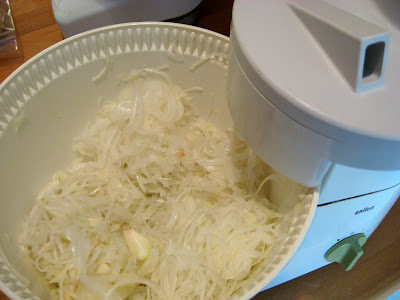
Peel the onions and cut into fine rings (or rather half-rings, for that matter). Peel and chop the garlic, or just throw into the vegetable slicer with the onions.
Usually, I have no problem cutting onions. Breathe in trough the mouth, out through the nose, and don't let the onion get close to your eyes. But this time, the combination of a still-lingering cold and the fact that I barely ever use my kitchen mixer's vegetable slicer for cutting onions made me drop my caution. All was fine while slicing the onions, but when I opened the thing to clean it, I got a whole whopping lung full of onion mist, and it worked like teargas. Hence me scaring our neighbour, again.
At least the cold was truly gone afterwards.


In a large pot, melt the butter over medium heat and add the onions. Boil until the moisture has evaporated, but make sure not to brown the onions. Reduce to low heat and simmer until very soft and fragrant, while stirring occasionally.
If you want, you can go all the way here and caramelize the onions in this step. That is, continuing to gently simmer them until they are brown(ish) and really sweet, without ever letting them get too hot else they would burn. This adds some more taste, but I can't find any real difference in the finished soup as long as the onions have had enough time to simmer on their own.

Add the flour and the spices, stir and simmer for a few more minutes.

Turn up the heat and add wine and stock, if you use water you might want to add some salt.
This recipe gives the wine / water ratio I prefer, but it works nicely with pure wine as well. Though I can't imagine the recipe working with water only... A shot glass of pastis or another strong anise liquor can be added at this stage for added complexity - if you like anise.

Bring to boil, then reduce heat and leave to simmer. Cook until the alcohol has evaporated, and the soup tastes sweet and harmonious, at least an hour, though longer is better here.
This is one thing that never fails to amaze me. The difference such a long cooking time makes is stunning especially as it is just time you add, no special ingredient. Well, then again, maybe time IS the special ingredient here. But it harmonizes the strong flavours of the soup, turning it from so-so to nom-nom.
I usually prepare this dish late morning, then leave it to simmer until I return into the kitchen for an afternoon tea. So I'd say, three or four hours simmering would be optimal.


Right before serving, heat up the grill of your oven. Slice the bread and toast lightly with some butter until crisp.

Distribute the soup into ovenproof bowls, put the bread on top and cover with cheese. Run under the very hot grill until the cheese is molten and bubbly, then serve immediately.

Can be served in small portions as a starter, or as given in this recipe, as a moderate main. Goes perfectly with most dry white wines.