23 February 2009

a perfect little treat


This is not much of a recipe, just a note and a few pictures to let you see what we have been up to.

The weekend was busy and relaxing as weekends should be, and of course we had to have some kind of treat to go with our tea on sunday afternoon. This time, the wife wished for 'her' banana cake, and it once again turned out quite lovely.


It's nothing but a shortbread pastry case filled with sliced fresh bananas and topped with a thick, dark chocolate ganache. So, for a pastry base of 30 cm in diametre I use 200g of cream and 200g of dark (65%) chocolate to make a ganache of the proper texture. The wife is very discerning in that regard.


This cake is crisp and creamy at the same time, the rather bitter chocolate a very welcome foil for the mellow sweetness of the bananas. Cool out of the fridge, it is just a perfect little treat when you are looking for something sweet and indulgent but not too heavy or fussy to prepare.

17 February 2009

if you're adventurous, take coarse sea salt


Living in Germany, foodwise, is pretty great. It isn't France, nor Italy, nor anywhere near the Mediterranean sea, for that matter, but food quality and variety is great for comparatively low prizes.

Yet, for all the variety and cosmopolitan influences of my childhood home, some things just skipped me by.

For example, the only two options for breakfast cereals you have here are either the entirely artificial commercial cereals or some dusty muesli.

Somehow, I instinctively knew that there had to be something missing between those two options. Something crunchy, slightly sweet, (almost) as healthy as muesli just without the dust.

I actually had no idea that something like granola even existed.

So you can imagine my immediate intrigue when I first stumbled over a granola recipe in this wondrous treasure cave of the Internet. Soon, granola became a household staple and has enjoyed international acclaim since then. (Greetings to Denmark, btw!)


This recipe has already come a long way - I adapted it from Molly of Orangette's french chocolate granola, which in turn has evolved out of David Lebovitz' honey crunch granola. Now talk about evolution...

Anyway, it is right what I have been looking for all these years - slightly sweet and crunchy and nutty, with flavors of caramel and bread and sun. An entirely good-natured treat and a great anti-depressant.


my (french) (honey crunch) granola
(makes three to four large jars of about a litre each - which is what I comfortably eat in two months)

500g rolled oats
250g coconut flakes
300g almonds in flakes
100g hazelnuts in flakes

4 tablespoons unrefined cane sugar
4 tablespoons neutral oil (ie sunflower)
12 tablespoons light honey
1 teaspoon cinnamon powder
1 teaspoon salt (if you're adventurous, take coarse sea salt... I love it^^)
1/2 teaspoon ground aniseed

In a small casserole, gently heat the sugar, oil, honey and spices until the sugar has mostly dissolved and the mix is very runny. Stir often.
Watch out, honey can get very hot and sticky and might give you burns to remember better for the rest of your life.

In a large(!) bowl, mix the oats and the nuts. Pour over the warm honey and stir well until all grains are coated.
Once the honey cools down, the mix will turn sticky and quite unwieldy. I used a ten liter bowl just to make sure I wasn't making a mess of my kitchen.

Heat the oven to 150°C and roast the granola on a sheet lined with parchment / non-stick paper. The surface will brown quite swiftly, so stir the mix once or twice to have as much sugar caramelize on the grains without letting it burn. Depending on the moisture content of the oats and the honey, it will take about 20 to 25 minutes until it is sufficiently browned for me, but you might want to adapt the time to suit your personal taste.

Let the granola cool down completely before putting it into airtight containers.
Stir the granola once or twice while cooling, else it'll coalesce into one large brick instead of myriads of glassy-sounding little flakes.

As long as it doesn't catch any moisture, this granola keeps very well, at least two to three months.

I prefer this with some sultanas and a banana with a lot of plain creamy yogurt as a light office lunch, but it is equally nice on plain yogurt with some honey, on ice cream, or as a crunchy topping for your porridge.

11 February 2009

roasted with honey


Just so you don't come to think that we subsist on cream and bacon alone:


This was our dinner on monday night, just a few vegetables fried with honey and a lot of pepper and some of my chiabattini, roasted with honey as well. Nothing much of a recipe to talk about, but tasty, filling, healthy and definitely pretty enough, isn't it?

09 February 2009

stocking up on spices


Since tuesday last week, our pantry is now a veritable larder.

See, we have this charming lady coming over every few weeks or so to cut our hair. And as she has a large garden, a large family and is friends with my mum-in-law and generally plain sweet, she usually brings some surplus seasonal vegetable with her for us to eat.

Only this time, she and her husband had recently started home smoking their own meat. And probably just to show off, she brought us a sizeable slab of glistening, home-smoked fat bacon. So gorgeous.

It is now hanging in the larder, making the room deserve its name properly for the first time. The whole basement is flooded with the scent of wood smoke and it makes me smile each time I pass the door.

Having a decently stocked larder is such a good feeling.

And with 'decently stocked larder' I do not only mean 'having all you need', but rather 'having a comfortable cushion if things go wrong'. Of course, I do not honestly consider a famine a serious possibility where I live, and there will always be a supermarket around the corner. But even though, there is a deep, gut-level satisfaction in having stored at least a little more than what we will need in the immediate future.

It felt good already when we moved into our current home and suddenly had a room in the basement that would be dedicated to nothing but the storage of food. But the real jolt came when my mum-in-law order a hundredweight(!) sack of wheat and rye each(!) for making her own bread. Seriously, there was more than my own weight in grains standing in the corner.

But after my initial shock subsided (How long exactly did you think we will be living on these?), I felt happy. Positively glowingly happy.

It took me a while to figure out why having this (apparently) unreasonable amount of cereals in my basement made me anything other than worried. It is hard to put in words, but it was something along the line of 'let the winter come'. It felt secure, on a very instinctive level. As if somewhere, in the deep back of my mind, evolution had managed to genetically engrain the fact that a stock of food large enough to see me through a hard winter will significantly ease my mind. Actually, that makes some kind of sense.

Maybe, as I come to think of it, humans didn't descend from apes after all, but from squirrels. At least, that would explain a lot about myself.

Anyway, I ususally strife only to stock up on things I can reasonably expect to use up before they expire (unlike my mom-in-law). So, that means dry goods and spices, which work just fine with me.

One of my special darlings is my jar of pre-mixed curry powder. Just a few spoons of this mixture will turn an otherwise rather bland dish into something extraordinarily complex, spicy, fragrant. And as it wouldn't make sense to mix microscopic portions of the various ingredients each time, I mix it in bulk and keep until I need it.

Which is more and more often, especially after I found out how the curry mix improves something lovely but a little bland like spinach and eggs. I like spinach and eggs, but the 'indian' version we are currently making is in a completely different league.

Try it and see for yourself - it'll just give you the reason you were looking for to go stocking up on spices.


Curry Type I

1 tablespoon each of
curcuma (tumeric)
cumin
coriander seeds
sweet paprika

1/4 tablespoon chilies (or more to taste)
1/4 tablespoon cinnamon


If necessary, grind the spices. Mix them and store in an airtight container in a dark place (ie a screw-lid jar, see above).


Curried Eggs
serves two

400g spinach, frozen
200ml coconut cream, unsweetened
2 tablespoons curry type I
salt

4 eggs
2 teaspoons tumeric (curcuma)
1 tablespoon clarified butter (ghee)

roasted onions to taste


In a medium casserole, thaw the spinach and gently heat with the coconut cream and the spices.

Meanwhile, boil the eggs.
I prefer them at 8 minutes, when the yolk is firm but still glossy.

When the eggs are ready, cool them a little under running cold water, then peel.

In the same pot the eggs were cooked in, melt the butter at medium temperature. Add the curcuma and the peeled eggs. Fry gently until coppery all around.
The eggs should sizzle gently in the spiced butter, but not hiss or spit.

Salt the spinach to taste, it should have a consistency somewhere between gravy and ordinary spinach.

Serve immediately with the eggs (and roasted onions if you like), and maybe some bread as a side.

07 February 2009

therapeutical baking


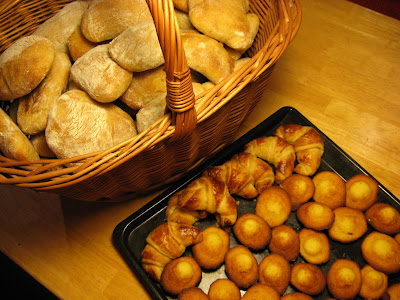
Our stock of ciabattini was running low, so I decided I would make a new batch to keep in the freezer.


That is actually my grandmother's mangle linen the ciabattini are resting on. It had been part of her dowry and been hiding away for years in my cupboard, but now it is perfectly serving its new purpose of helping me making bread.

Also, my copy of Suas' Advanced Bread and Pastry arrived this week. Good god, now this is the first cooking book I really, really find helpful. If ever you wondered 'why' during baking, this is the book for you.

So I was eager to try some new things, and naturally I wasn't short of comissions. My dad-in-law asked me to try and make some Madeleines, as the ones he used to eat with his afternoon coffee in the office were no-where in the shops anymore. So, I bought a form and made some Madeleines -


They turned out marvelous. Only thing is that I will need another form with bigger and more Madeleines per charge. Well, we'll see how they keep, and if^^.

Also, I wanted to try and make croissants for my wife. So I did a batch of them as well.


Those didn't turn out that good actually, because the butter I used for layering was too thick and too cold and kinda messed up the whole process. So, the structure was way below optimal, though the taste already was pretty damn close to what I was looking for.

I learned a real damn lot today - especially
a) Madeleine dough gets better the longer it is cooled (the last batch 6 hours after the first one produced the best ones).
b) a triple batch of ciabatta is about the maximum I can comfortably bake at once in my kitchen, because the last ones were pretty overproof already.
c) I spent a whole day baking and I feel like I had a week of holidays. Talk about therapeutical baking - only my feet hurt.


02 February 2009

a hand-me-down souvenir


Even the best vacation has a definite drawback - eventually, you'll have to get back home.

Sure, there are vacations where going home is the best part. But, right now I am talking about good holidays, those trips far away where you lose the track of time and everything seems somehow enchanted.

And yet even those vacations end eventually, leaving nothing but memories.

Though, of course, we can always bring some physical proof that we had been there, some trinket that'll remind us when our memories start to fade.

We can bring souvenirs.
(Which, incidentally, is the french word for 'memories'...)

I love going on vacations. But I really cannot stand stuff that clutters up my place, being of no use until one day it is forgotten along with the original memory and yet can still be found.
(Alright, even I keep a tiny stone that I found at the Cape of Good Hope. It's just to nice a thing to throw away and not really cluttering up my place.)

So usually, I try quite hard not to buy some trinket that hangs around. Instead, as a reminder, I try to learn things. New skills, new recipes, things that are immaterial but innately useful.

Like the way I learned to flip crepes in the pan without touching them. Like the 'moules a la creme' that my wife found at the Mont St. Michel. Like learning how to make mayonnaise from scratch when I was in Portugal with 60 hungry boyscouts.

Those skills are 'things' in terms of not really being memories of events. They are part of me like breathing, I don't have to remember them. And yet, each time I make mayonnaise, I can recall the scent of the pine needles on the camping site north of Porto where I first made some. Those skills all have the added benefit of reminding me of vacations, and they can't gather dust.

Best of all - they work with second-hand vacations, too!

This week's recipe has been brought back home by my mother, after a vacation my parents spent sailing with some of their friends. I don't even remember where exactly they were, and I hardly know the friends they were with, but I am so sure I can recall it was a vacation with great food. That's what I call a hand-me-down souvenir!

This is a rather simple ragout, with only a few ingredients. But the flavours are astonishingly well matched, with a tablespoon of mustard working some serious magic in the background without ever being prominent enough to be noticed by anyone who didn't see me putting it in. It looks rather unassuming but is quite a stunner, trust me on that.

(And if you close your eyes, and chew carefully, I bet you too will be able to feel the yacht gently rocking in the evening breeze...)


Ragout Ashkelon
(serves four)

800g chicken breast (deboned)
2 bundles of scallions
1 tablespoon butter, clarified
0,5 l chicken stock
0,5 l cream
1 generous tablespoon mustard
flour to thicken
salt, pepper


Clean the meat, if necessary. Cut into nicely bite-sized pieces.

Clean the scallions of dry parts, discard the roots. Roughly half the batches so you have one part predominantly white, the other one predominantly green. Separately chop into rings.
Actually, look at the picture below. This was what greeted me when I came home from work, all clean and chopped and neatly 'mise en place'.
I am married to the best commis in the world.


In a high-rimmed, heavy pan, heat the clarified butter and sear the meat.
At this step, turn up the heat as high as your stove can give you. Even try to get a nice, hazel color on the chicken and even some crisp corners. No need to actually have the meat thoroughly done right now, it'll get enough time later on. Right now, this is about color and getting some inportant taste.

Once the meat is nicely browned, reduce to medium heat and add the white part of the scallions. Gently fry together for a minute, until the scallions turn glassy.
Now it is important not to have the pan too hot, cause once the scallions burn even ever so slightly, you'll never get that taste out of the dish again.

Add the stock, returning to full heat. Bring to a boil and leave to deglaze for a moment. Meanwhile, whisk the flour into the cold cream until well dissolved.
As you can see, this will give quite a lot of sauce, which I love. Usually this amount calls for about two tablespoons flour, but you can always take the shortcut and use some commercial thickener.
Or you can go the long way and take the time to prepare a proper roux, of course, adding a perfect silken texture to this already luxurious dish.
Whatever your time management allows for.


Add the floured cream to the pan and bring to a soft boil, stirring gently.

Season with the mustard, salt and pepper.
Usually, I take mustard 'a l'ancienne', with coarsly ground grains for this dish as it looks much better. But half of my eaters that evening weren't too fond of mustard in general and so I took the smoothly ground one and didn't tell them.

Right before serving, stir in the green parts of the scallions.
Not really cooking the greens will give a lovely crunch to the dish and a nice, lively flavour.

Serve with rice and a cool, dry white wine.


27 January 2009

simple, delightful and entirely messy


Do you remember that bowl of aioli, standing slighly forlorn next to the ciabatta in last week's post?

No?

Well, no need to, actually. It just happened to stand next to the bread, and now as I am looking at the images for this week's post, I realise that there isn't a single one of the aioli with the food it was originally meant to go with.

I don't even have a single image of the aioli just by itself. Which, in my eyes, is quite a shame - it would have deserved one. It is THAT good. With bread, with prawns, with almost about anything else except itself.

(As a sidenote - just one thing that several guests on one of our annual summer parties have learned in quite a nasty way - never, never place the aioli next to anything that looks like it could go with vanilla custard. Woodruff jelly and aioli are a strict no-go.)

But, as already mentioned, it is close to unbeatable when it accompanies seafood, especially crustaceans. And even though as a kid I first learned to like the french 'crabes araignée' with homemade mayonnaise, today I'm rather a fan of the spanish version - gambas con aioli.

Simple, delightful and entirely messy, they're perfect if the dreary winter weather calls for some summery food to lift up your spirits. Though, admittedly, they're at least as good in the middle of summer, fresh and steaming from the barbecue.


gambas con aioli
(serves four as starters or two as main)
(aioli not pictured)


for the 'gambas'
1kg king prawns, whole and raw
50ml soy sauce
juice of one lemon
1 tablespoon honey
a pinch of pepper and / or chili


for the aioli
2 eggyolks
200ml - 250ml vegtable oil (sunflower, preferrably)
1 clove of garlic
1/2 teaspoon salt
3 teaspoons lemonjuice, maybe more
1 teaspoon honey
optional: a tiny pinch of ground saffron


Defrost and / or clean the prawns, if necessary.
We usually buy them frozen, size 16-18 (meaning that there are 16 to 18 prawns in a kilogramm) at our local wholesale market. Of course, if you want to go extravagant on a really nice barbecue, you can always buy one huge one per person, which would be rather expensive but always makes one hell of a posh plate.

Cut open the tails of the prawns with a sharp knife or a kitchen hatchet, beginning at the 'chest' between the legs and cutting lengthwise down to their tailfins.
If you just want to ease the later peeling and allow some marinade touch the meat, it is enough to cut the prawn's belly and leave the back intact. Especially on a grill and with bigger specimen, I prefer also cutting the back, because then you'll get two 'curls' of prawn that almost look too pretty to eat.

De-vein if necessary.

Mix the remaining ingredients for the marinade in a big bowl until the honey is dissolved. Toss the prawns with the marinade until they are well-covered, the leave to rest for about half an hour, longer for bigger prawns.

For the aioli, put the yolks in a high, narrow mixing bowl. Mix with the handheld mixer at the highest setting, then add the oil. Only add a few drops(!) at first, then mix until well combined. Then you can add about half a teaspoon, then more and more until you have a very, very stiff, almost glassy rudimentary mayonnaise.
The amount of oil you need varies significantly with the size of the yolks, the temperature and probably a hundred different things I have no clue of. I just add oil until the mix feels really stiff, like fluffy butter.

Add the crushed garlic, lemon juice, honey and salt, and mix until well combined.
Try to balance the taste of lemon, honey and salt. There is a point where you can hardly tell them apart, and that is where the aioli goes from 'garlicky mayonnaise' to 'nom nom nom...' or rather 'gobble gobbble gobble...'. Usually, I just add the lemon juice and add touches of salt and honey until I have the right balance. In this case, I have given the amounts you'll approximately need for a rather mild version, though you can surely double the amount of lemon juice and get a really, really pungent (really tasty, but maybe exhausting) result.

If you want, you can also add a pinch of ground saffron for more colour and a more original, spanish taste.
If you add saffron strings, you'll end up with bright red lines in your aioli, bleeding orange, but then again I can imagine that little bit of added colour being wanted. If you only have saffron strings, grind them with a mortar and pestle with the salt from above and add with the salt. I usually omit the saffron, as the wife doesn't really like it.

Chill the aioli at least twenty minutes, and stir well before serving.
There is very little moisture for the salt to dissolve in. So even if you use very finely ground salt, it'll make weird white specks on the aioli in the first minutes or crunch if you eat it right away.

Drain the gambas from the marinade. Either drop them into a rather hot skillet with just a hint of oil or put them on the grill, whatever season and equipment allows. Fry on both sides until just done, shouldn't take more than 10 - 15 minutes.

If you want some gravy besides the aioli, you can deglaze the pan with some of the marinade and a piece of butter.

Serve immediately, with white wine and something to clean your hands afterwards. Enjoy!